
Electric Blanket Controller Problems: What OEM Buyers Should Test Before Bulk Production
Electric blanket controller problems can lead to returns, warranty claims and production risks. This OEM buyer guide explains…
November 13, 2026
Buying heated under blankets for a bedding range involves more than choosing a size and unit price. This guide helps retailers compare flat, fitted and padded formats, check mattress compatibility, confirm heating and electrical specifications, and prepare a clear RFQ before sampling or bulk production.
CONTACT US
Bedding Retail Buyer Guide
An underblanket can look like a simple bedding accessory, but small specification gaps—mattress depth, elastic fit, heating coverage, controller setup or care instructions—can create costly problems after a wholesale order arrives. This guide helps bedding retailers, importers and private-label brands compare the main formats and prepare a clearer product brief before sampling.
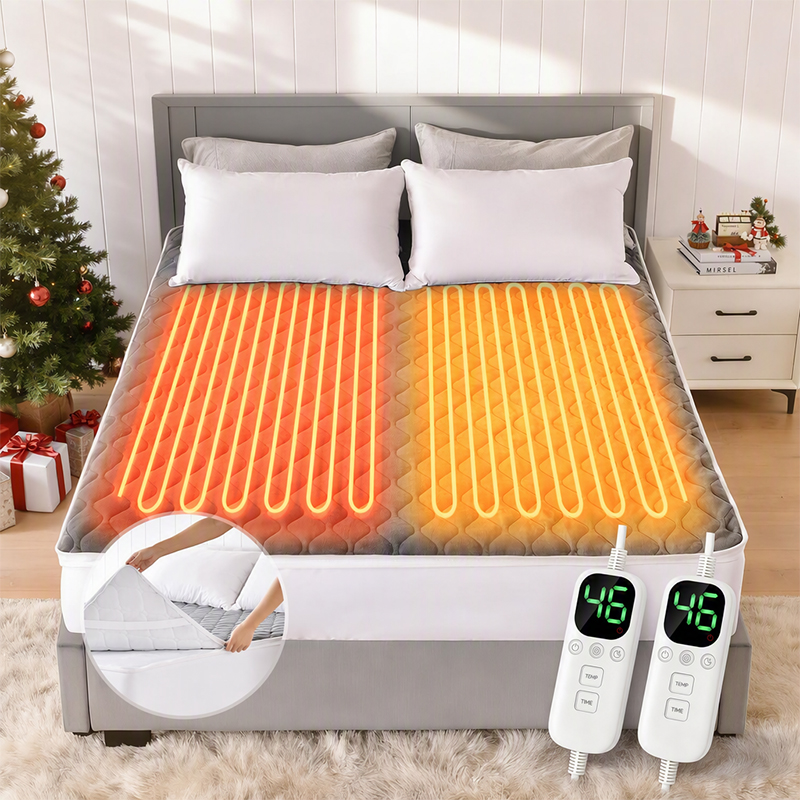
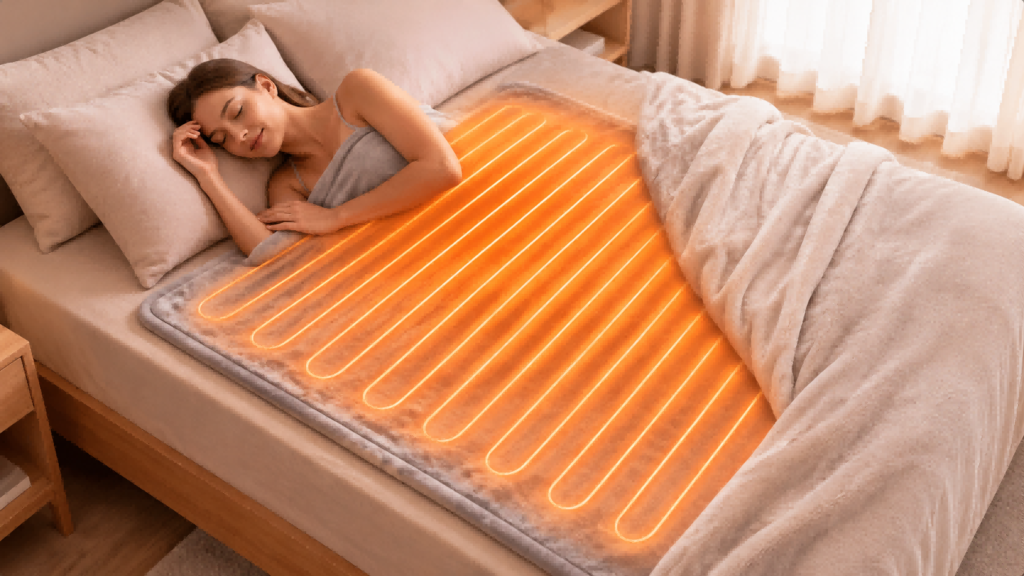
A heated under blanket is designed to sit on the mattress, beneath the regular bed sheet. Its job is to warm the sleeping surface from below. Depending on the model, it may be a flat rectangular layer, a fitted design with elasticated sides or a more padded mattress-pad construction.
For a model-specific reference, see the HEATMATE Dual-Control Heated Mattress Pad and compare its approved product details with the requirements of your target market.
A traditional heated blanket or heated throw is generally placed over the user. Although both product types use flexible heating technology, their placement changes the construction brief, the way the product is secured, the required dimensions and the information buyers need to confirm before production.
| Comparison point | Heated under blanket / heated mattress pad | Heated overblanket / heated throw |
|---|---|---|
| Primary purpose | Warms the mattress sleeping surface from below | Provides warmth over the body |
| Placement | On the mattress, beneath the regular bed sheet, according to the product instructions | Over the body or across the bed or sofa |
| Construction focus | Mattress dimensions, corner retention, skirt depth and fit | Blanket dimensions, drape, hand-feel and edge finishing |
| Heating layout | Designed around the intended sleeping area | Designed around the intended body-covering area |
| Retail positioning | Bedding accessories and bedroom comfort | Home comfort, sofa throws and seasonal gifting |
For retailers, the distinction matters at the product-listing stage as well as during sourcing. A customer looking for a mattress warmer may not consider a sofa throw an equivalent product. Use the terminology familiar in the target market, and make the intended placement clear in product titles, images, packaging and care instructions.
Buyers comparing adjacent product categories can also review HEATMATE’s electric heating product range to see how underblankets sit alongside throws and other heated products.
The main construction decision is not simply whether the product looks premium. It is how securely it fits the mattress, how much surface padding it provides and which customer or price tier the retailer intends to serve.
A flat underblanket has a simple rectangular shape and is laid over the mattress. It may suit buyers who want a straightforward bedding accessory with fewer fitted construction details. However, the retailer should not assume that one flat size will suit every mattress. Finished dimensions, placement guidance and the method used to prevent shifting all need to be confirmed.
Fitted designs use elasticated edges, a skirt or another securing construction to hold the product around the mattress. They can provide a more stable fit, but mattress depth becomes a critical buying specification. A fitted underblanket that matches the mattress width and length but has an unsuitable skirt depth may be difficult to install or may not stay in position.
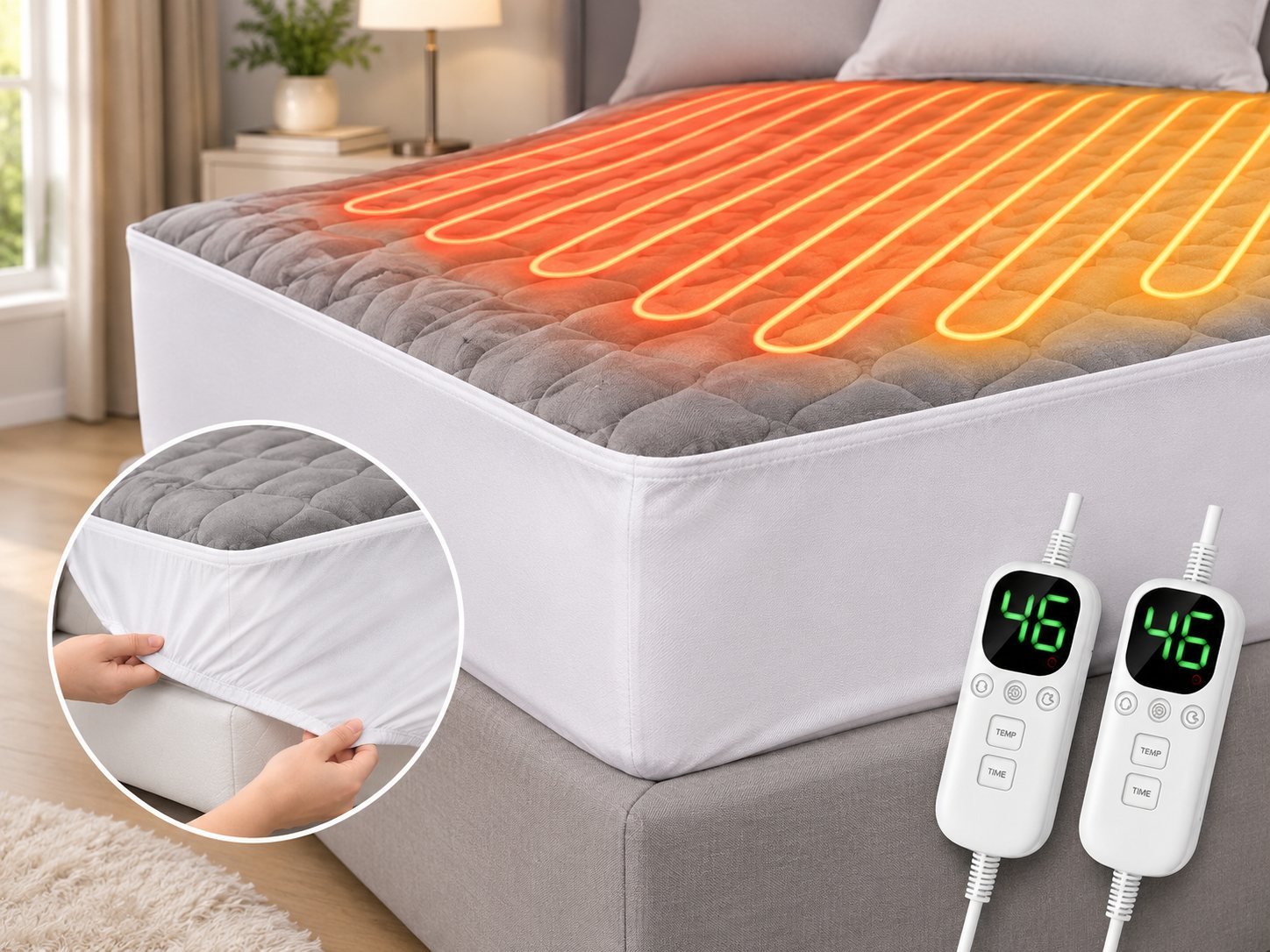
Some heated mattress pads combine the heating system with a thicker or more cushioned textile construction. This can change the hand-feel and the way the product is presented in a bedding collection. It also makes thickness, quilting, fabric composition and care requirements more important during sample review.
For wholesale buyers, the key is to define what “padded” means in measurable terms. Ask for the fabric composition, construction, target thickness or fabric weight where applicable, and the finished dimensions. A product photograph alone is not enough to compare two suppliers’ offers.
For heated under blankets, fit is one of the most visible parts of product quality. A product may have consistent heating performance and an attractive fabric surface, yet still disappoint customers if it bunches, pulls away from the corners or does not cover the intended mattress area.
Ask the supplier for the finished length and width of the underblanket, not only a retail size name such as Twin, Full, Queen or King. Size names can vary between countries and retailers. If a product is intended for more than one market, create a size chart using the dimensions that apply to each destination.
For fitted models, record the mattress depth the product is designed to accommodate. If the target customer commonly uses a mattress topper or pillow-top mattress, decide whether that extra height must be included in the fit specification. Do not assume that an elastic skirt will stretch sufficiently without a sample check.
The outside dimensions of a mattress pad do not necessarily describe the exact area that receives heat. Ask the manufacturer to identify the intended heating coverage and any unheated border areas. This information helps buyers compare models and write accurate product descriptions without implying that every part of the pad heats in the same way.
Test the sample on a mattress with the type of sheet and bedding arrangement expected in the target channel. If adjustable bases, split mattresses or unusual mattress constructions are part of the intended market, raise those conditions before the design is finalized. Compatibility should be confirmed for the specific model and its instructions.
Heating zones influence the product’s target customer, control layout and price positioning. A single-zone model is generally simpler to explain and may suit standard bedding ranges. A dual-zone model is designed to let two sides of a bed be adjusted independently, which can be relevant for couples with different temperature preferences.

| Buyer consideration | Single-zone | Dual-zone |
|---|---|---|
| Control arrangement | One heating area controlled as one zone | Two heating areas intended for independent adjustment |
| Typical target user | Single sleepers and standard bedding collections | Couples or premium bedding customers with different preferences |
| Product complexity | Usually a simpler control and specification brief | Requires confirmation of separate zone operation and control arrangement |
| Retail positioning | Entry to mid-range, depending on fabric and functions | Potential premium or feature-led bedding range |
| Sample checks | Confirm coverage, temperature control and operating functions | Test each side separately and confirm that the controls operate as specified |
Do not assume that two controller sockets or two visible control units automatically mean two independently adjustable heating zones. Ask the manufacturer to explain the control arrangement and demonstrate each side during sample review. Confirm how the product behaves when one side is adjusted while the other remains at a different setting.
For a reference model, see HEATMATE’s dual-control heated mattress pad. Buyers should confirm the current model dimensions, electrical configuration and market-specific documentation before using it as the basis for a quotation.
A complete product brief makes supplier quotations easier to compare. If one factory quotes a fitted model with a deep skirt and another quotes a flat pad with no securing method, the unit prices do not represent the same product.
| Specification area | What the buyer should define | What to confirm with the supplier |
|---|---|---|
| Product construction | Flat, fitted or padded mattress-pad design | Construction drawing or clear sample reference |
| Dimensions | Finished length, width and permitted tolerance | Measured sample and size chart for each SKU |
| Mattress fit | Target mattress depth and securing method | Skirt depth, elastic arrangement and corner fit |
| Fabric | Fiber composition, fabric type, color and surface finish | Material specification and approved swatch |
| Padding and quilting | Layer structure, thickness or fabric weight where relevant | Cross-section or construction details and sample consistency |
| Heating layout | Intended coverage and single- or dual-zone arrangement | Heating-area drawing and functional demonstration |
| Electrical system | Destination voltage, frequency, rated input and plug | Model-specific electrical ratings and component configuration |
| Controller | Heat settings, timer, display and number of control units | Function list, connector type and user instructions |
| Care requirements | Whether the product is washable and the intended care route | Detachable components, washing method and care label |
| Branding and packaging | Logo, labels, manual, retail box, barcode and carton details | Artwork proof, packaging sample and carton specification |
| Compliance | Target country and required conformity route | Reports and documents matching the finished model |
Keep the final specification in one controlled document. If the fabric, controller, heating layout, voltage, plug or other important component changes after approval, record the change and decide whether the sample, test evidence or customer approval needs to be updated.
A sample should be reviewed against the specification, not simply judged by whether it looks and feels good on arrival. For an underblanket, the mattress itself is part of the test setup.
For a more detailed discussion of production checks, link this review to HEATMATE’s guide on electric blanket safety testing and quality inspection. That article covers broader electrical and finished-product checks; this section focuses on the fit and construction issues specific to underblankets.
Electrical bedding should be developed for its intended market from the beginning. The applicable standard and conformity route can depend on the product category, rated voltage, control unit, destination country and the exact finished configuration.
IEC 60335-2-17 addresses the safety of electric blankets, pads, clothing and similar flexible heating appliances, including associated control units. The IEC’s current consolidated publication is IEC 60335-2-17:2022+AMD1:2026, published in October 2026. Buyers should ask their testing partner which edition and national adoption apply to the intended market; the newest IEC publication should not be assumed to replace every local transition or adoption rule automatically.
For the United States, UL 964 covers electrically heated bedding, including blankets, sheets and mattress pads, for the supply conditions described in its scope. The applicable certification and evaluation route should be confirmed for the actual product and electrical configuration.
For the European market, CE marking is not simply a generic certificate supplied with a product. The responsible manufacturer must identify the applicable EU rules, complete the relevant conformity assessment, prepare technical documentation and issue an EU Declaration of Conformity where required. The European Commission’s CE marking guidance explains these responsibilities.
Requirements in the UK, Australia, New Zealand and other markets should be reviewed separately. A report prepared for one market or one model does not automatically establish compliance in every destination.
When comparing suppliers, focus on whether they can reproduce the construction you need—not just whether they already manufacture electric blankets in general. Underblankets bring mattress-fit questions that are easy to overlook when a supplier mainly shows heated throws or overblankets.
For a broader supplier assessment, see how to choose an electric blanket manufacturer. Use that guide for factory capability and supplier due diligence, while keeping this article’s mattress-fit and underblanket questions in your product specification.
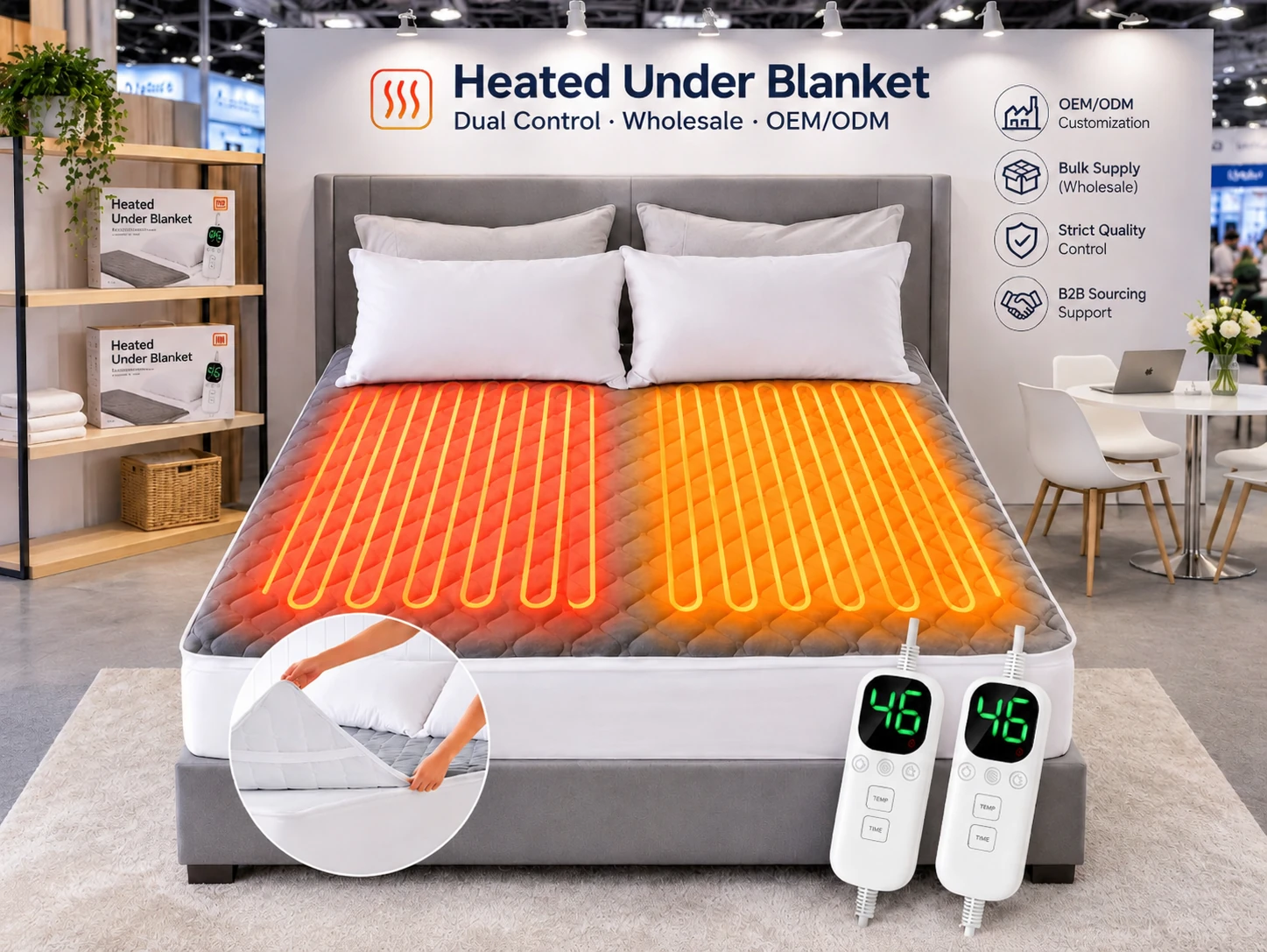
Private-label development can go beyond adding a logo to an existing product. Depending on the factory’s engineering capability and the project requirements, buyers may be able to customize dimensions, fitted construction, fabric, color, quilting, heating zones, controller functions, labels and retail packaging.
Define who will buy the product and what mattress types they are likely to use. This helps determine whether a flat, fitted or padded design is the most practical starting point.
Record dimensions, mattress depth, fabric composition, color, quilting, heating coverage and control functions. A phrase such as “soft premium fabric” is not a production specification; use an approved swatch and measurable material details wherever possible.
Voltage, frequency, plug, controller and heating configuration should be aligned with the target market before the sample is finalized. Late changes can affect the development schedule and may require further review or testing.
Retail labels, care instructions, warning information, product photography, packaging and carton markings should match the approved product. For the complete development process, see HEATMATE’s OEM electric blanket customization guide.
Before requesting quotations, prepare the following information. If an item is not decided yet, mark it as “to be proposed” rather than leaving suppliers to make different assumptions.
When comparing quotations, make sure every supplier is pricing the same construction, size, electrical setup, packaging level and compliance scope. A lower unit price may simply reflect a different product specification.
The terms are often used for similar mattress-warming products, but naming and construction can vary by market and supplier. Confirm whether the product is flat, fitted or padded, and check its intended placement and instructions rather than relying on the product name alone.
Neither is universally better. Flat designs can simplify construction and size planning, while fitted designs may offer more secure mattress positioning. The right option depends on target mattress dimensions, depth, customer preference and retail positioning.
There is no single depth that applies to every model. Buyers should specify the mattress depth they want to accommodate and verify the skirt or elastic construction on a physical sample.
A true dual-zone design allows two sides of the bed to be adjusted independently. Buyers should confirm the control arrangement and test each side separately before approving the sample.
That depends on the model’s construction and instructions. Do not assume all underblankets are machine washable. Confirm which components must be detached, the approved washing method and the required drying process for the exact model.
Requirements depend on the destination market and the finished product. IEC 60335-2-17 and UL 964 are relevant references for flexible heating appliances and electrically heated bedding, but buyers must confirm the applicable local route, product scope and model-specific documentation.
Share the target market, product format, mattress size and depth, fabric preference, heating-zone configuration, voltage and plug, controller functions, estimated quantity, branding and packaging requirements. This gives the supplier a clearer basis for a comparable quotation.
Share your target market, mattress dimensions, preferred construction, heating-zone requirements and estimated order quantity. HEATMATE can review the product brief and discuss suitable underblanket or heated mattress pad options for wholesale and OEM/ODM development.
Discuss Your Under Blanket ProjectThis article is general sourcing information, not a substitute for model-specific technical instructions or destination-market compliance advice. Confirm all product specifications and applicable requirements before placing a bulk order.
HEATMATE is an OEM/ODM manufacturer specializing in electric heating products, including heated blankets, heated throws, heated underblankets, USB heated scarves, heated jackets and related products.

More manufacturing knowledge for global heating-product buyers.
Electric blanket controller problems can lead to returns, warranty claims and production risks. This OEM buyer guide explains…
Cold spots and uneven heating are not always caused by blanket size. This buyer guide explains heating coverage,…

Why do some machine washable electric blankets stop heating after cleaning? This buyer guide explains wash-test requirements, heating-wire…
Partner with HEATMATE for professional heating solutions.
GET FREE QUOTEIf you have any questions, please do not hesitate to contact us.