Electric Blanket Controller Problems: What OEM Buyers Should Test Before Bulk Production
Electric blanket controller problems can lead to returns, warranty claims and production risks. This OEM buyer guide explains…
November 13, 2026
Why do some machine washable electric blankets stop heating after cleaning? This buyer guide explains wash-test requirements, heating-wire durability, fabric stability, care labels and the checks retailers and private-label brands should complete before bulk production.
CONTACT US
“Machine washable” is one of the most attractive convenience claims in the electric blanket category. For retailers, wholesalers, importers and private-label brands, however, washability is not simply a care-label feature. It is a product durability requirement involving heating-wire construction, connector protection, fabric stability, electrical performance and clear consumer instructions.
Machine washable electric blankets are popular because consumers expect bedding and home-comfort textiles to be easy to clean. Buyers comparing different constructions can also review HEATMATE’s electric blanket product range to see how fabric, size and heating configurations vary across models. That convenience also creates a technical challenge: the textile has to survive water, detergent, mechanical movement, spinning and drying while the internal heating system remains stable.
A blanket may look completely normal after washing and still develop cold spots, unstable heating, connector problems or an open heating circuit. This is why retailers and private-label buyers should treat machine washability as a measurable product specification, not as a simple catalog phrase.
Washing places several types of stress on an electric blanket at the same time. The textile bends, twists and compresses in the drum; the heating system moves with the fabric; the connector area experiences repeated mechanical load; and the entire product is exposed to moisture and detergent.
If one part of the construction is weaker than the rest, the blanket may continue to look acceptable externally while electrical performance changes internally.
Heating wires are one of the most important internal components in an electric blanket. During washing, repeated bending and movement can increase stress on the wire layout, especially when the internal routing is not securely fixed.
Buyers should check:
The blanket-side connector and the transition point between the heating circuit and external controller deserve particular attention. These areas may experience moisture exposure and repeated mechanical movement during washing.
For models using detachable controllers, buyers should confirm whether the controller and power lead must be removed before washing, how the remaining connector is protected, and whether the connector assembly has been evaluated after repeated washing and reconnection.
Washability is not only an electrical issue. If the face fabric, backing layer, binding or internal textile structure shrinks unevenly, extra tension can be transferred to the heating system.
Common electric blanket fabrics such as flannel fleece, polar fleece, crystal velvet, sherpa and microfiber can behave differently under washing and drying conditions. Buyers should therefore define dimensional stability and not rely only on the fabric name.
Even a correctly designed washable electric blanket can be damaged if the user selects a more aggressive wash or drying process than the product was designed to tolerate.
Important variables include water temperature, washing-machine type, cycle intensity, spin condition, detergent and drying method. High-temperature washing, strong agitation, wringing or unsupported high-heat drying may shorten product life.

No. Electric blankets can use very different internal structures and cleaning methods. For example, HEATMATE’s electric heating blanket is positioned as machine washable, but the approved care process still needs to match the exact model specification. A detachable controller can make washing more practical, but it does not automatically prove that the complete textile heating product is suitable for machine washing.
| Product Construction | Typical Cleaning Approach | Buyer Considerations |
|---|---|---|
| Detachable controller design | Machine washing may be permitted after controller removal | Connector protection, approved cycle, drying method and post-wash electrical performance |
| Fixed electrical connection | Manufacturer-specific cleaning method | Water exposure limits and electrical component protection |
| Non-detachable heating system | May require restricted cleaning or surface cleaning | Whether the complete construction has been tested for the claimed method |
| Removable heating insert | Textile cover can sometimes be washed separately | Ease of removal, reinstallation and correct consumer use |
For wholesale and private-label projects, the safest approach is to treat washability as a model-specific specification. If the supplier changes the fabric, heating element, connector, internal fixation method or sewing structure, buyers should confirm whether the previous wash-test result still applies.
Supplier statements such as “machine washable” or “washable design” are useful starting points, but they should be supported by clear test conditions and documented results before a large order is approved.
The testing method should reflect the washing instructions that will eventually appear on the product label and user manual. If packaging claims that the blanket can be machine washed at 30°C, the validation process should use corresponding conditions rather than a less demanding internal test.
A visual inspection is not enough. The blanket may look normal while electrical behavior has changed. Buyers can compare these checks with HEATMATE’s electric blanket safety testing and quality inspection guide, which covers heating performance, wiring connections, insulation and final inspection points.

Depending on the model and applicable test plan, post-wash checks may include:
One successful wash cycle demonstrates only that the product survived one wash. It does not provide much information about longer-term consumer use.
For private-label programs, buyers and manufacturers should agree on a repeated-wash requirement that matches the product’s intended retail position. If the project also involves custom fabrics, sizes, heating systems, labels or packaging, review HEATMATE’s heated blanket OEM & ODM services before finalizing the specification. At defined intervals, the sample can be evaluated for heating function, temperature uniformity, fabric shrinkage, internal movement, connector condition and overall electrical performance.
A development sample can pass a wash test while later mass-production units use slightly different fabric, connector components, sewing methods or internal fixation.
Washability should therefore be tied to the approved sample, bill of materials and production specification. Material substitutions that could influence wash durability should be reviewed rather than treated as routine factory changes. The same principle applies to sample approval and bulk-production consistency, where an approved Golden Sample and controlled specifications help reduce variation between development samples and mass production.
If machine washability is part of the retail promise, it should be written into the product specification before production begins.
A written specification gives procurement, quality control and the factory a shared reference. It also reduces the risk that marketing claims are created separately from the tested product conditions.
Clear care instructions help customers use an electric blanket correctly and can reduce unnecessary after-sales complaints.
Retailers and private-label brands should keep washing information consistent across the sewn-in care label, packaging, user manual and online product page.
Drying instructions should be as clear as washing instructions. If tumble drying is prohibited, the restriction should be prominent. If only low-temperature tumble drying is approved, the permitted condition should be stated accurately.
Wash-related complaints can affect retail margins, product reviews and long-term brand reputation. The most effective approach is to control the risk during product development and production rather than waiting until after-sales data begins to show a pattern.

| Control Point | Recommended Buyer Action | Why It Matters |
|---|---|---|
| Product development | Agree on washing and drying claims before finalizing construction | Aligns engineering with the final retail promise |
| Sample approval | Approve a model-specific golden sample after wash testing | Creates a reference for mass production |
| Material control | Control changes to fabrics, connectors and heating components | Reduces variation between tested samples and production units |
| Production QC | Inspect heating layout, connectors, seams and functional performance | Wash durability depends on consistent assembly |
| Pre-shipment inspection | Verify function, labels, manuals and approved product specifications | Helps catch inconsistencies before shipment |
| After-sales analysis | Track return reasons by failure type | Separates washing issues from controller, cable or user-instruction problems |
A supplier that can answer these questions with model-specific specifications, test records and approved samples gives the buyer a much stronger basis for a machine-washable retail claim.
No. Washing suitability depends on the product construction and the manufacturer’s tested care method. Buyers should follow the exact instructions for the approved model.
No. Removing the controller is only one part of the design. The heating element, blanket-side connector, internal fixation and textile construction must also tolerate the approved washing process.
Ask for the approved washing method, number of test cycles, post-wash performance records, relevant electrical testing, fabric stability information and a model-specific sample.
Internal heating wires, terminals or connector areas can be stressed without visible damage to the external textile. This is why electrical checks are important after repeated wash testing.
Define washability requirements before production, approve the tested sample, control material substitutions, verify care instructions and track after-sales failure modes.
Machine washability is a valuable feature in the electric blanket category, but the claim should be supported by product construction and repeatable testing.
For retailers, wholesalers and private-label brands, the key purchasing points are heating-wire durability, connector protection, fabric dimensional stability, repeated wash-test performance, post-wash electrical checks and clear care instructions.
HEATMATE supports OEM/ODM electric blanket development for global business partners, including fabric selection, product dimensions, heating functions, controller configurations, labels, branding and packaging. Washability requirements can be discussed during product development so the care claim, test plan and final construction are aligned before mass production.
Share your target market, blanket size, fabric preference, heating functions, washing requirements and expected order quantity. HEATMATE can help review the product specification and OEM/ODM development requirements before bulk production.
Discuss Your ProjectHEATMATE is an OEM/ODM manufacturer specializing in electric heating products, including heated blankets, heated throws, heated underblankets, USB heated scarves, heated jackets and related products.
More manufacturing knowledge for global heating-product buyers.
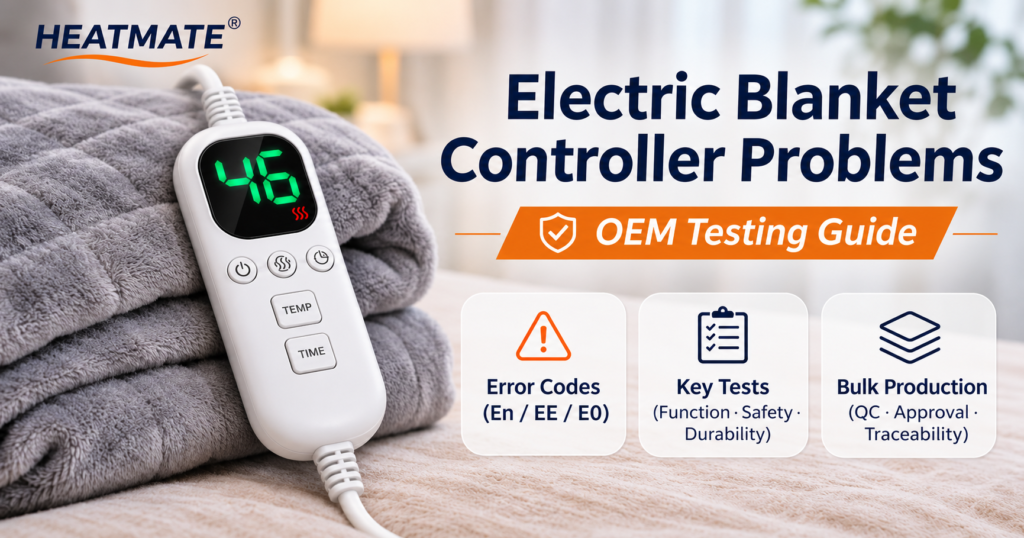
Electric blanket controller problems can lead to returns, warranty claims and production risks. This OEM buyer guide explains…
Cold spots and uneven heating are not always caused by blanket size. This buyer guide explains heating coverage,…

Looking for a heated pillow manufacturer? Explore heated lumbar support pillow designs, USB power configurations, heating and massage…
Partner with HEATMATE for professional heating solutions.
GET FREE QUOTEIf you have any questions, please do not hesitate to contact us.